Where We Stand in the 119th Congress

ICA is engaged regularly with Members of Congress, committee staff, and officials across the Administration. We work in professional collaboration wherever and whenever it advances the profession and patient’s interest — within the profession, across the integrative health community, and with any Member of Congress of any party who will move the ball forward.
Our federal agenda has four priorities.
| Priority | What we are working to achieve |
| Medicare | Pass H.R. 539 / S. 106 with three profession-wide improvements, ending a fifty-plus-year limitation that covers one chiropractic service and no others. |
| Nondiscrimination | Enforce Section 2706(a) of the Public Health Service Act so health plans stop discriminating against providers acting within their state license. |
| Those who served | Direct access to chiropractic care for veterans, service members, and federal employees, without arbitrary referral requirements or visit caps. |
| Research | Dedicated, sustained federal investment in chiropractic research, led by Doctors of Chiropractic. |
Priority One: Improving Medicare Through — H.R. 539 / S. 106 –with 3 revisions
Barriers Implemented By Congress in 1972 Remain Unresolved
Congress brought chiropractic into Medicare in the Social Security Amendments of 1972 in the midst of the ‘contain and eliminate’ organized attack on the profession. As a result, the statute defines the Doctor of Chiropractic as a physician “but only” for manual manipulation of the spine to correct a subluxation. Everything else a state licenses a Doctor of Chiropractic to do — the examination, the diagnostic imaging that informs the adjustment, the evaluation and management visit — falls outside coverage. The senior pays out of pocket for services that are covered when performed by another physician-level provider. This is a long standing discrimination against the profession and the Medicare Beneficiaries who seek chiropractic care.
Since it was added to the law in the early 1990s, Medicare beneficiaries are also barred from privately contracting with their Doctor of Chiropractic on the same terms available to them for all other physician level providers (M.D. or D.O. etc.). A senior who wishes to pay privately for chiropractic care faces a restriction that does not apply elsewhere in Medicare.
A United Profession, One Bill – Your Leadership at Work
ICA President Dr. Joe Betz has engaged in a bridge building activity across the chiropractic profession which brings us to an opportunity to get Medicare legislation passed. In May 2026, ICA and the American Chiropractic Association issued a joint statement committing to collaborate on patient access.
“Seniors have waited fifty-four years for Medicare to cover more than one chiropractic service. With the profession united and this bill in committee, we intend to finish it.” — Joseph Betz, D.C., President, International Chiropractors Association
In June, the MAHA Chiropractic Hub launched, and both associations signed a Memorandum of Understanding aligning policy priorities behind a single Medicare vehicle (2). The national associations that have historically approached this issue differently are now working the same bill, at the same time, toward the same result. ICA supports H.R. 539 and S. 106, the Chiropractic Medicare Coverage Modernization Act, with the following 3 improvements:
| # | Improvement | Why it matters to patients |
| 1 | Coverage defined by each state’s authorized scope of practice, with drugs, surgery, and obstetrics expressly excluded. | The benefit follows the license the state already granted. Medicare is a payer, not a scope authority, and nothing in the bill changes any state’s scope. The express exclusion keeps chiropractic in the lane of chiropractic and puts to rest any suggestion that this is a back door to prescribing. |
| 2 | Private contracting parity for Doctors of Chiropractic, modeled on the existing physician framework. | A Medicare beneficiary may privately contract with an M.D. or D.O. The same beneficiary cannot do so with a Doctor of Chiropractic. Correcting this restores a freedom the patient already has everywhere else in the program. |
| 3 | A firm implementation date written into the statute. | Without a deadline, a passed bill becomes a multi-year rulemaking with no guaranteed outcome. Seniors have waited since 1972. A date certain converts a promise into a benefit. |
What the bill needs now
H.R. 539 has broad bipartisan support — roughly 169 House cosponsors, close to evenly divided between the parties, with 15 cosponsors on the Senate companion (9,12). Both bills sit in committee. What they need is a committee markup with a score, and floor action before this Congress adjourns.
There is no procedural shortcut. Legislation moves when Members hear from the people they represent.
ICA’s standing Medicare principles
- Cover the standards of care: evaluation and management services, and diagnostic imaging, not the adjustment alone.
- Preserve coverage of the chiropractic adjustment to correct a vertebral subluxation, and preserve the subluxation reference in the statutory definition.
- Instruct CMS to use the existing physician codes and rates rather than creating chiropractic-specific codes at lower reimbursement.
- Establish reimbursement equity with other physician-level providers.
- Maintain economic neutrality by removing barriers to reimbursement for services Medicare already covers.
- Keep prescribing out of chiropractic in Medicare.
- Give CMS clear, specific direction with deadlines — not open-ended discretion.
Take Action
- Find out where your Representative and Senators stand on H.R. 539 and S. 106.
- If they are not cosponsors, ask them to cosponsor. If they are, ask them to press their committee leadership for a markup this session.
- Call the office after you write. A phone call from a constituent who is a practicing doctor or a patient carries weight that an email does not.
- Tell us what you hear back. Constituent intelligence shapes where we spend our time on the Hill.
ICA Focuses on Legislation and Policy
Priority Two: Ending Provider Discrimination — Section 2706(a)
Section 2706(a) of the Public Health Service Act states that a group health plan may not discriminate against a health care provider acting within the scope of that provider’s state license or certification (8). The provision has been law for more than a decade. It has never been meaningfully enforced.
ICA published a detailed policy report in July 2026 documenting how the provision has gone unenforced, what enforcement would require, and how the same nondiscrimination principle should be extended across Medicare, Medicaid, TRICARE, the Veterans Health Administration, and the Federal Employees Health Benefits Program. ICA endorses Section 2706(a) as a matter of provider nondiscrimination; that endorsement is specific to this provision.
The discrimination is not abstract. It shows up as referral and gatekeeping requirements imposed on chiropractic and not on comparable care; as visit caps set by benefit design rather than by the treating doctor’s clinical evaluation; as heavier prior-authorization and documentation burdens; as code-level exclusions; and as lower payment for the same work. Each of these substitutes an administrative judgment for a clinical one, and each narrows what the patient is ever told is available.
Priority Three: Veterans, Service Members, and Federal Employees
Chiropractic care is available in the Department of Veterans Affairs and, in a more limited way, in the Military Health System — but access is uneven. Veterans report arbitrary visit caps, payment delays, and billing obstacles in community care. TRICARE beneficiaries generally require a primary care manager referral before they can see a Doctor of Chiropractic. ICA is working to remove these barriers.
- Direct access to chiropractic care in VA and community care, without a mandatory medical referral standing between the veteran and the care.
- Expansion of chiropractic services across the Military Health System and TRICARE.
- Recognition of the Doctor of Chiropractic as a qualifying degree for commissioning — in the armed forces, and in the United States Public Health Service Commissioned Corps, where the Department of Health and Human Services already holds the authority to act.
- A parity standard for chiropractic benefits in the Federal Employees Health Benefits Program.
Priority Four: Research Worthy of the Profession
Policy follows evidence, and evidence follows funding. Creating a dedicated Division of Chiropractic Research within the National Institutes of Health, funded at a level that permits significant clinical and basic science research and led by a Doctor of Chiropractic. Chiropractic has been included in Medicare since 1972 and in the VA for more than two decades, and it has never had a federal research home of its own. That gap is now the profession’s most consequential structural disadvantage in every policy conversation.
The existing literature already supports the argument. Patients with spinal pain who received chiropractic care had roughly half the risk of filling an opioid prescription over a six-year period compared with those who did not . A meta-analysis of six cohort studies covering 62,624 patients found substantially lower odds of receiving an opioid prescription among recipients of chiropractic care. What is missing is not signal. It is sustained investment.
Whole-Person Health and the Chronic Disease Crisis
The national conversation has turned toward prevention, root causes, and reducing dependence on drugs and surgery for conditions that respond to conservative care. Chiropractic has made that case for a century. ICA is working to keep non-drug, patient-controlled, lifestyle-centered care at the center of chronic disease policy — and to ensure that the professions delivering that care are included in federal programs on equal terms.
Prevention is not a slogan. For a senior with spinal pain, it is the difference between an adjustment and an opioid prescription, between conservative care and a surgical consult. Patients deserve to be told that choice exists, and to be able to afford it.
State-Level Advocacy: Protecting Chiropractic as a Distinct Profession
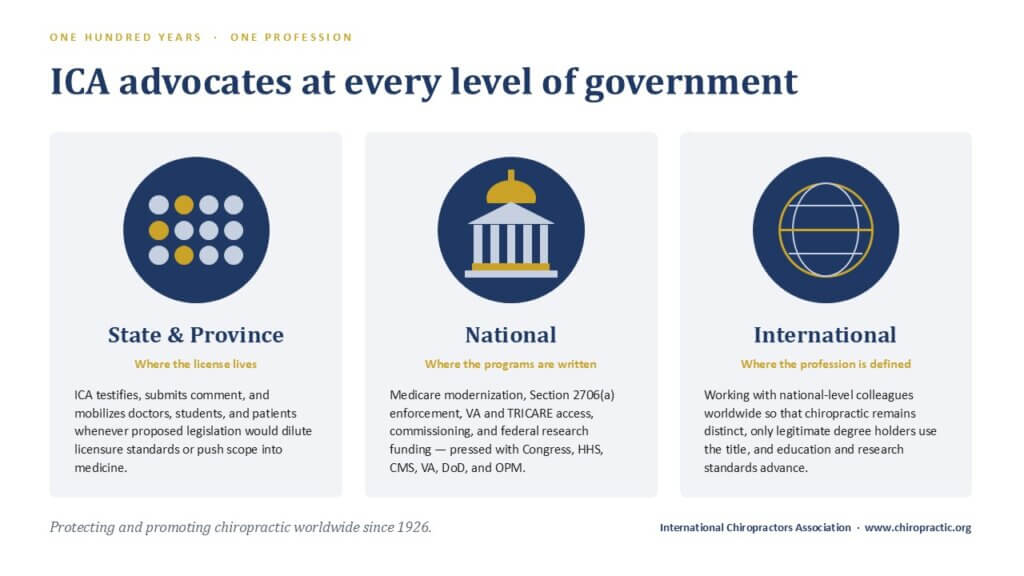
A century ago, ICA fought to establish a fair and appropriate Doctor of Chiropractic license in every state and territory. We still do that work. When proposed legislation or regulation would blur chiropractic into medicine, dilute licensure standards, or expand scope into prescribing, ICA speaks up — in writing, in committee, and in person. ICA has testified against scope-expansion legislation in state after state, and we will continue to.
We also equip the people who care about chiropractic — doctors, students, and patients — to advocate for themselves. Understanding what a bill actually says is the first act of effective advocacy.
International Advocacy -Promoting the Profession Worldwide
ICA works with national-level colleagues around the world to ensure chiropractic remains a distinct profession, that only those holding legitimate degrees may call themselves chiropractors, and that the public is protected from unqualified individuals presenting themselves as such. We support our international schools and colleagues in advancing research, education, and licensure standards.

“Medicine is the study of disease and what causes man to die. Chiropractic is the study of health and what causes man to live.“
– B.J. PALMER
Last updated on September 8, 2026 at 1:31 pm